
🌐 Unlocking Cloud Security: A Deep Dive into Microsoft Entra Permissions Management (EPM)
“Taming the Cloud Chaos: How Microsoft Entra Permissions Management Redefines Identity and Access Governance”

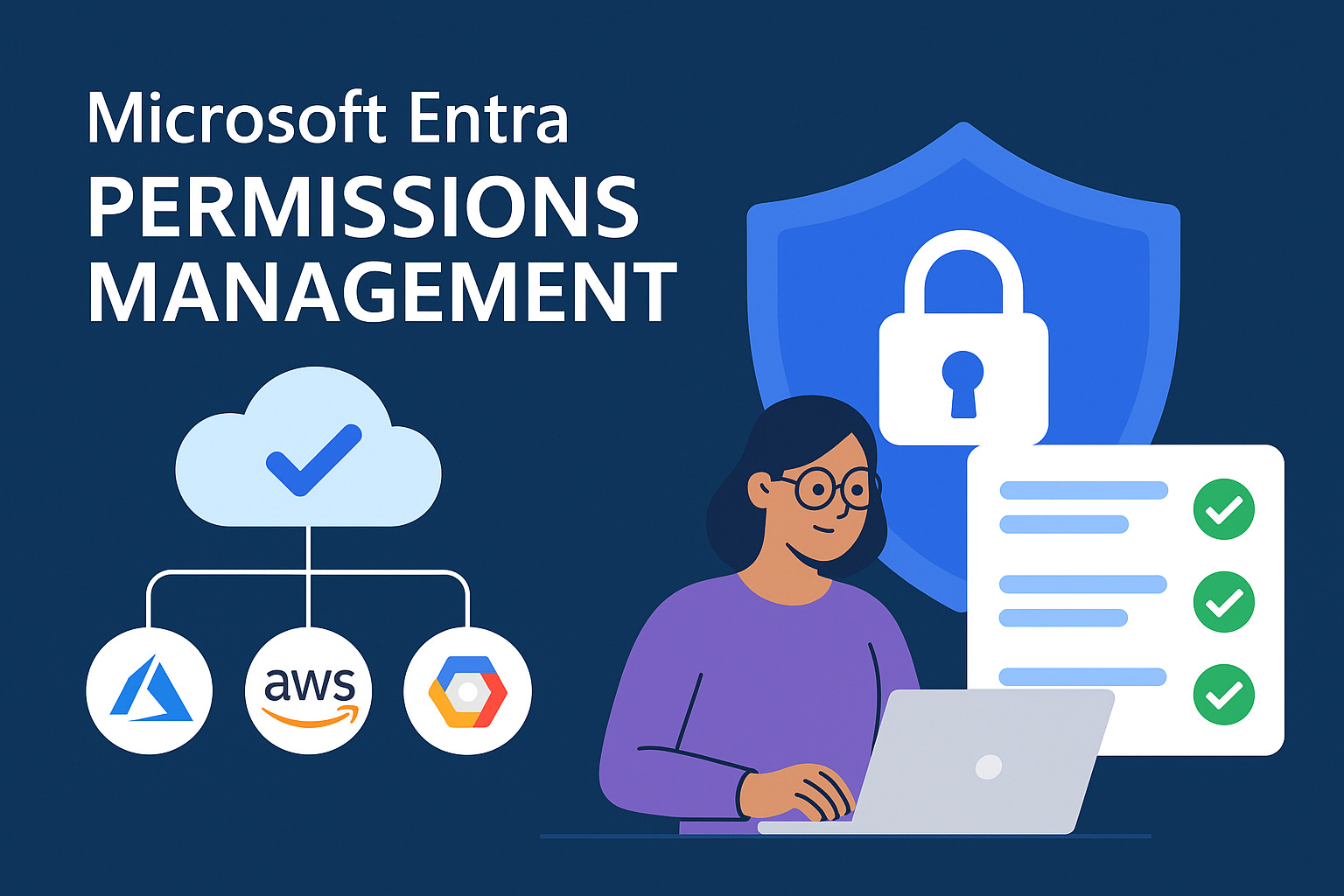
Cloud computing has become the backbone of modern digital transformation. Enterprises are no longer confined to a single platform — they run workloads across Azure, AWS, and Google Cloud simultaneously. This agility, however, comes at a cost: permissions sprawl.
Every developer, service principal, container, or workload often accumulates more access rights than necessary. According to Gartner, by 2026, 75% of cloud security failures will result from inadequate management of identities, access, and permissions. Attackers know this — and are actively exploiting excessive permissions for privilege escalation, lateral movement, and data exfiltration.
This is where Microsoft Entra Permissions Management (EPM) comes in. Positioned under the Microsoft Entra product family, EPM is a Cloud Infrastructure Entitlement Management (CIEM) solution that provides visibility, control, and remediation of permissions across multi-cloud environments.
🔎 What is Entra Permissions Management (EPM)?
EPM enables organizations to adopt least privilege at scale by discovering and analyzing entitlements across users, applications, service principals, and workloads. Unlike traditional identity management (which focuses mainly on authentication and SSO), EPM zooms in on effective permissions — the true level of access that identities have, not just what was assigned.
EPM helps security leaders answer three critical questions:
Who has access? (employees, contractors, apps, bots, service accounts)
What can they actually do with that access? (effective privileges across cloud workloads)
Should they still have this access? (governance, compliance, and lifecycle reviews)
🛠 Core Capabilities of EPM
1️⃣ Comprehensive Permissions Discovery
Microsoft Entra Permissions Management delivers deep visibility into all identities, roles, and resources across Azure, AWS, and Google Cloud, ensuring no entitlement remains hidden.
Provides a unified, single-pane-of-glass view for multi-cloud permissions, eliminating the complexity of navigating individual IAM consoles for each platform.
Continuously maps identities and associated permissions, including users, workloads, service accounts, and managed identities, to give a holistic view of access relationships.
Analyzes effective permissions, factoring in nested groups, inherited role assignments, custom policies, and cross-tenant configurations to uncover the actual privileges users can exercise.
🔍 Real-world scenario:
A cloud engineer is directly assigned “Contributor” rights on an Azure subscription but inherits “User Access Administrator” permissions through group membership.
This combination silently elevates their access, enabling them to modify role assignments — a hidden privilege escalation risk.
EPM identifies and surfaces this compound permission path, providing actionable insight for immediate remediation.
2️⃣ Risk Detection and Threat Insights
EPM proactively detects permission-related risks that could be exploited by attackers or lead to compliance violations.
Identifies toxic permission combinations capable of destructive actions such as data deletion or privilege escalation.
Flags overprivileged or dormant identities, including service accounts with excessive access that haven’t been used for long periods (e.g., Global Admin accounts inactive for 120+ days).
Highlights shadow administrators — identities with indirect privilege escalation potential via inherited roles or policy chaining.
⚠️ Example:
An AWS Lambda function appears to have “read-only” permissions but also holds the capability to attach IAM policies.
If exploited, an attacker could elevate privileges and gain administrative control over the environment.
EPM exposes such latent privilege escalation risks, allowing security teams to take corrective action before a breach occurs.
3️⃣ Enforcing Least Privilege Access
EPM transforms the principle of least privilege from a static concept into an operational practice through continuous assessment and automation.
Generates customized role recommendations based on actual usage analytics, minimizing access without disrupting productivity.
Supports Just-In-Time (JIT) access provisioning, integrating seamlessly with Microsoft Entra Privileged Identity Management (PIM) to grant temporary elevated access only when required.
Automates remediation workflows, such as revoking dormant accounts, removing unused roles, or notifying owners of excessive privileges.
💡 Example:
A DevOps engineer consistently uses only three specific API actions within AWS but holds full AdministratorAccess.
EPM recommends a custom least-privilege role granting only those required actions, effectively minimizing exposure while maintaining operational efficiency.
4️⃣ Compliance and Audit Readiness
EPM simplifies regulatory alignment by automating access visibility, documentation, and evidence generation for key standards.
Provides pre-built compliance reports aligned with frameworks such as ISO 27001, SOC 2, HIPAA, GDPR, and NIST 800-53.
Automates access certification processes crucial for regulated sectors including finance, healthcare, and government.
Maintains a continuous, immutable audit trail for all permission changes, ensuring traceability throughout the identity lifecycle.
📊 Example:
During a SOX compliance audit, EPM can generate reports showing:
Who had privileged access to cloud environments,
When that access was last exercised,
Who approved the assignment, and
When it was last reviewed or revoked.
This enables auditors to validate access control effectiveness quickly and with verifiable evidence.
5️⃣ Multi-Cloud Permissions Governance
As enterprises expand into hybrid and multi-cloud ecosystems, consistent governance across platforms becomes essential.
Offers a unified permissions inventory across Azure, AWS, and GCP, consolidating entitlement visibility under a single governance framework.
Detects cross-cloud exposure risks, such as external contractors or third-party identities holding excessive privileges across multiple clouds.
Enables security teams to standardize policies, enforce consistent access controls, and align entitlement governance with enterprise Zero Trust objectives.
By centralizing multi-cloud visibility and enforcement, EPM helps organizations reduce complexity, strengthen control, and minimize attack surfaces across diverse environments.
🚀 Why EPM Matters Now
📈 Industry Trends
Cloud-native adoption has led to exponential growth in entitlements.
Service accounts & non-human identities now outnumber human accounts in most enterprises.
Insider threats are harder to detect when excessive permissions exist.
🛡 Security Benefits
Reduces attack surface by eliminating unused or risky permissions.
Strengthens Zero Trust strategies by enforcing least privilege.
Improves resilience against ransomware and cloud privilege escalation attacks.
📑 Business Benefits
Speeds up audit readiness and reduces compliance overhead.
Provides CISOs and auditors with clear, actionable reports.
Aligns cloud security with governance, risk, and compliance (GRC) programs.
📊 EPM in the Microsoft Entra Ecosystem
🔷 Microsoft Entra Family – Core Solutions and Their Purpose
Entra ID (formerly Azure AD) – Provides authentication, single sign-on (SSO), multi-factor authentication (MFA), and role-based access control (RBAC) to secure access across users, apps, and devices.
Entra Identity Governance – Manages the identity lifecycle through automated workflows, access reviews, and entitlement management, ensuring users have the right access at the right time.
Entra Permissions Management (EPM) – A multi-cloud Cloud Infrastructure Entitlement Management (CIEM) solution that delivers discovery, analysis, and remediation of excessive or risky permissions across Azure, AWS, and Google Cloud.
Entra Verified ID – Enables decentralized identity management using verifiable credentials, empowering users to own and share their digital identities securely.
Entra ID Protection – Provides risk-based conditional access and real-time identity risk detection, protecting against compromised accounts and anomalous sign-ins.
Together, these create a comprehensive identity security fabric that spans from authentication to entitlement governance.
✅ Real-World Use Cases
Key Use Cases and Benefits of Microsoft Entra Permissions Management (EPM)
🧾 Audit & Compliance
Generate detailed permissions and entitlement reports aligned with major regulatory frameworks such as SOX, ISO 27001, and HIPAA.
EPM helps compliance and security teams demonstrate access accountability, validate adherence to least privilege policies, and maintain auditable evidence of permissions across Azure, AWS, and Google Cloud.
☁️ Cloud Security Posture Management (CSPM) Integration
Seamlessly integrate EPM with Microsoft Defender for Cloud to enhance your Cloud Security Posture Management.
While Defender for Cloud focuses on identifying configuration and workload vulnerabilities, EPM strengthens posture by reducing privilege risks—uncovering and remediating excessive, unused, or misconfigured permissions that could be exploited in an attack.
🔐 Zero Trust Implementation
EPM operationalizes the Zero Trust principle of least privilege across multi-cloud environments.
It continuously monitors effective permissions and provides right-sizing recommendations to ensure identities, workloads, and service accounts only have the minimum access required to perform their functions—thereby reducing potential attack paths.
🚨 Incident Response and Forensics
During a security incident or breach investigation, EPM offers immediate visibility into which accounts held high-risk or privileged permissions, when they were last used, and whether they were involved in the suspicious activity.
This rapid insight allows security teams to contain threats faster, conduct root-cause analysis, and strengthen defenses against future attacks..
📚 Further Resources
✍️ Conclusion
Microsoft Entra Permissions Management (EPM) is not just another add-on in the security stack — it’s a critical control for modern cloud environments. By combining visibility, governance, and automation, it empowers organizations to:
Eliminate excessive permissions,
Simplify compliance,
Strengthen Zero Trust, and
Reduce risk across Azure, AWS, and Google Cloud.
In a world where permissions are the new perimeter, EPM ensures organizations can securely scale cloud adoption without leaving the door wide open for attackers.
🔐 The takeaway? If cloud is your growth engine, then Entra Permissions Management should be part of your identity-first security strategy.
About the Author
Sameer Bhanushali is a seasoned IT professional with extensive experience in designing and implementing robust security frameworks. Sameer has been instrumental in advancing security practices across various sectors. He holds advanced certifications in IAM and Security.
As an Architect, Sameer specializes in helping organizations navigate the complexities of modern cybersecurity challenges, focusing on enhancing security posture through innovative solutions and best practices. His commitment to advancing the field of cybersecurity is reflected in his thought leadership and dedication to protecting sensitive information in
🔗 LinkedIn Profile